Share this article:
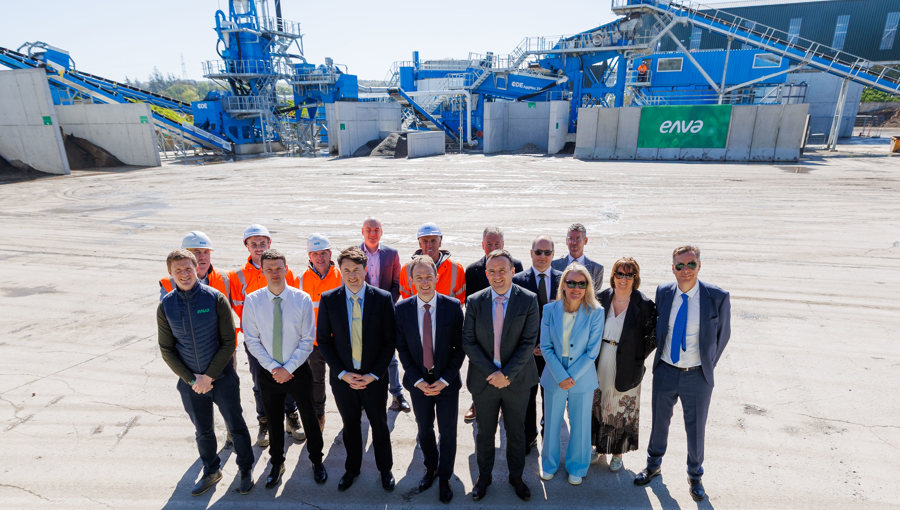
Enva recently officially opened its new Walshestown Resource Recovery Facility in Co. Kildare, representing one of the most significant recent investments in circular economy infrastructure for the Irish construction sector.
The facility, developed in partnership with wet-processing specialist CDE and supported by infrastructure investor I Squared Capital, is designed to recover high-quality recycled sand, soil and aggregate products from construction, demolition and excavation waste streams.
The facility is capable of processing up to 330,000 tonnes of material annually through a 180 tonnes-per-hour wet processing plant and is expected to recover approximately 70% of incoming material into reusable secondary aggregates. The development is particularly significant given that construction and demolition waste remains Ireland’s largest waste stream, with approximately 75% currently being directed to backfilling rather than higher-value recovery and reuse.
The Walshestown facility focuses primarily on brownfield construction and excavation materials and demonstrates the increasing shift toward engineered resource recovery systems capable of producing certified recycled aggregates suitable for infrastructure and construction applications. The project also highlights the growing role of End-of-Waste frameworks, EPA licensing, and quality-controlled secondary materials in supporting Ireland’s transition toward a more circular built environment.
The facility was recently visited by Alan Dillon TD, Minister of State with responsibility for the Circular Economy, who noted the importance of such infrastructure in supporting Ireland’s housing delivery, climate objectives, and reduction in reliance on virgin materials. The launch also reinforces wider policy discussions around the need for additional domestic recovery capacity, clearer regulatory pathways, streamlined End-of-Waste approvals, and stronger market acceptance of recycled construction materials through procurement and specification frameworks.
From a construction sector perspective, the development represents an important example of how private sector investment can support practical circular economy delivery at scale, while also helping address ongoing challenges around landfill dependency, soil and stone management, embodied carbon reduction, and long-term resource security within the Irish construction industry.